Understanding the Psychology of Level Design
Software used during the project:
Unreal Engine 5
Adobe Photoshop
Adobe Substance Painter
Autodesk 3ds Max
Canva
Github






As a Games Designer and QA developer, I feel it is important to include this in my portfolio, demonstrating an understanding of player attitudes and approaches to level design and general gameplay challenges. As part of coursework, I thoroughly researched over 50 scientific papers reguarding player psychology in video games. I conducted my own research into the topic, resulting in unique findings that aided in disproving the El Nasr theory on Intelligent Lighting for Game Environments, showing that player actions can be affected by light, even if player behaviour is inherently unpredictable.
Summary of Contributions
Constructed 4 game levels and their variant counterparts using Unreal Engine 5, resulting in 8 levels to test theories of psychological level design, focusing on the 4 key aspects of the study.
Planned and created gamified tests to accurately identify player behaviours in response to psychological stimuli within gaming environments and summarised the results by creating an academic poster using Adobe Photoshop and Canva.
Conducted user testing to gather primary data and test existing game development theories in a controlled environment.
Created the assets such as 3D models, game levels, decals, user interface, animations and blueprints required for the study.
Conducted testing to ensure the shipped product was of a professional standard for participant use.
The Study:
AN INVESTIGATION INTO HOW LEVEL DESIGN AFFECTS PLAYER PSYCHOLOGY AND THE RESULTING GAMEPLAY ACTIONS.
The first stage of the study included a large literature review of existing media and theories within the games industry so that an appropriate test could be constructed and developed for participants to undergo within the study.
The testing stage of the study included the development of the following levels:
Level 1 – Colour Theory – Used colour to indicate where players should navigate within a level.
Level 2 – Spacing – Used blank and overcrowded areas to funnel player movement.
Level 3 – Lighting – Used light to guide the player throughout the level, illuminating areas of interest and darkening unimportant areas to draw attention to objective locations.
Level 4 – Breadcrumbs – Used collectables to lead players through the level, encouraging movements such as jumping and pathfinding.
Each level was created using the Advanced Locomotion System (ALS) to allow for increased movement options, giving players greater freedom to traverse the environment and helping them understand gameplay rules as the experience progressed. The character camera was set to third‑person to improve spatial awareness and provide clearer visibility of the level’s layout. Levels were intentionally kept short and displayed no narrative or visual art style, as the focus was solely on level design and the extent to which psychological techniques could support it.
Findings of the study:
The study found that colour theory is a highly effective psychological tool in level design. When used correctly, colour can positively influence player behaviour and guide movement through an environment. However, colour must align with the level’s art style; mismatched palettes can break immersion and reduce clarity.
Whitescaping produced similar navigational benefits. Clean, readable layouts helped players find their way even without explicit objectives. In contrast, cluttered or messy layouts caused confusion, frustration, and less enjoyable gameplay experiences.
The study also challenged earlier claims that lighting has limited influence on player behaviour. Results showed that lighting can meaningfully affect player actions, even when behaviour is inherently unpredictable. Bright, focused lighting drew players toward key areas, while darker spaces reduced attention on non‑essential elements.
Breadcrumbing proved to be one of the most effective methods for directing player movement. Collectables encouraged exploration, jumping, and pathfinding, especially when risk or challenge was involved. These results supported the “Oh, shiny” principle described by Despain, demonstrating how players naturally gravitate toward visually rewarding stimuli.
Overall, the study suggests that level designers should make full use of psychological tools when creating digital environments. Understanding how these reinforcers shape player behaviour allows designers to build clearer, more communicative levels, leading to more predictable gameplay actions and smoother, less frustrating player experiences.
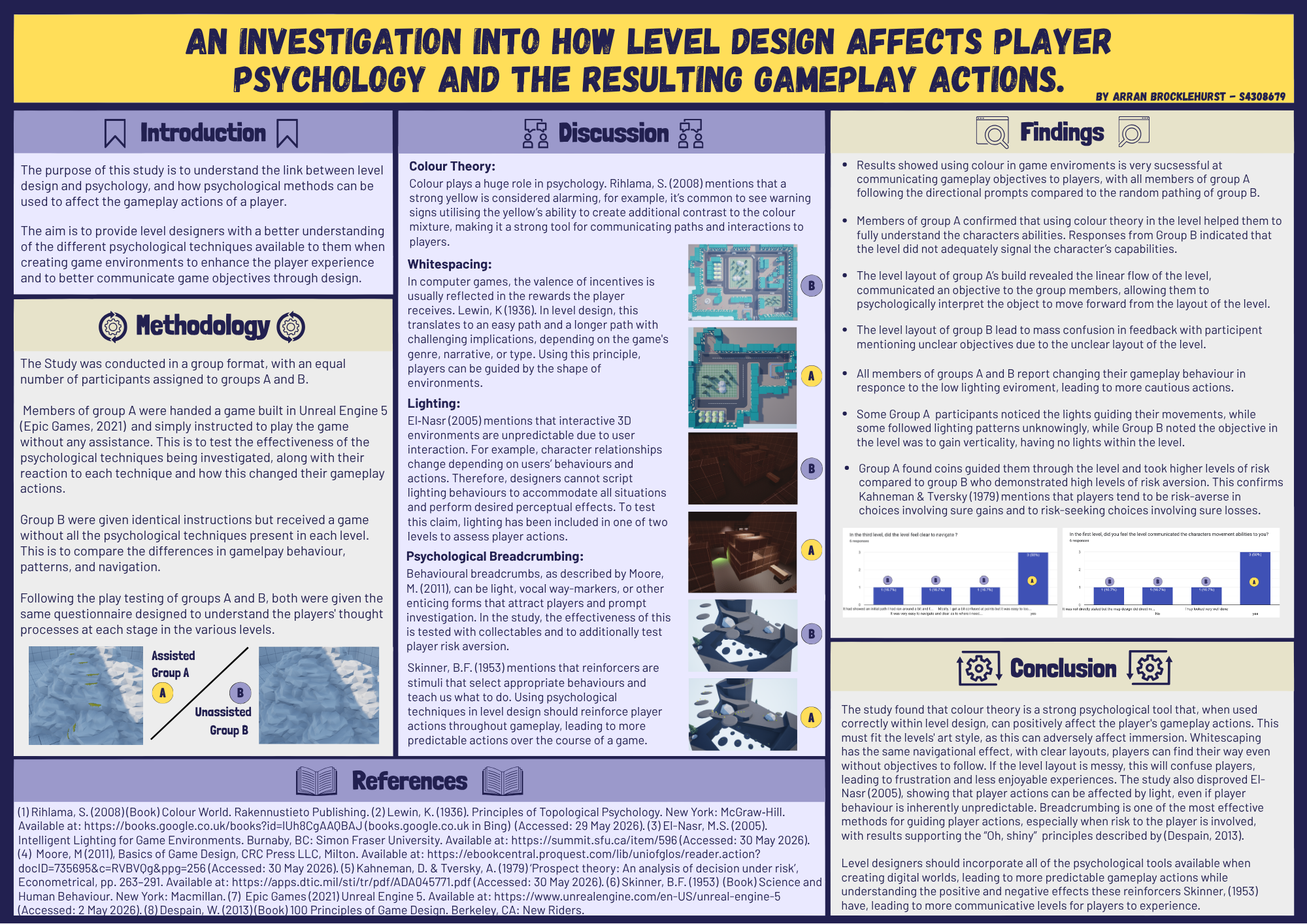
Poster displaying the results of the study:
Development Video and Public Testing Results Review: